AI Isn't Making People Less Intelligent — It's Exposing Who Never Had an Edge
There's a growing genre of articles warning that AI will make us cognitively weaker. The phrase “cognitive offloading” gets thrown around as if delegating tasks to tools is some unprecedented moral failure.
It isn't. It's how progress has always worked.
The problem isn't AI. The problem is people who never developed an edge to begin with.
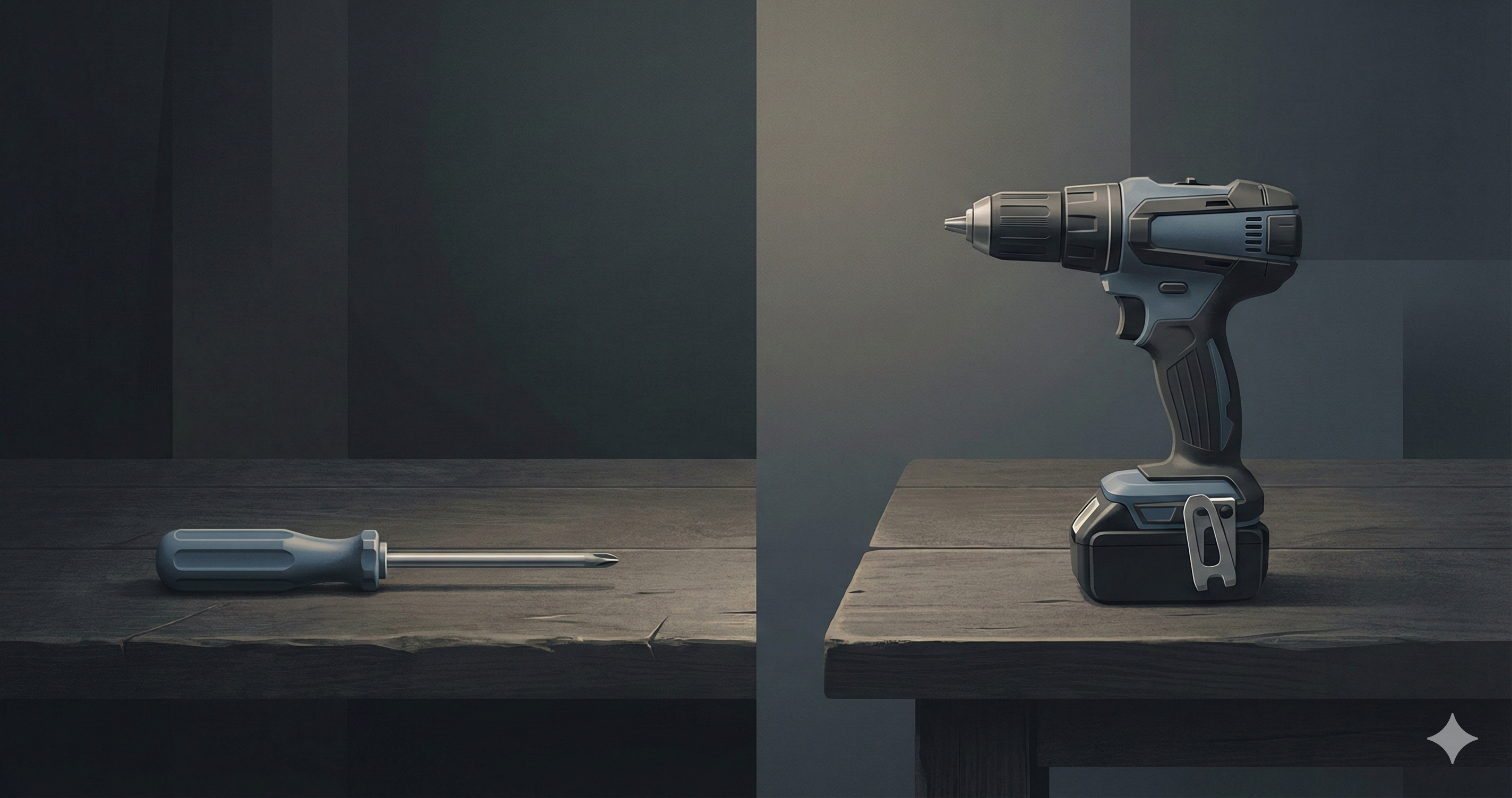
Tools Don't Remove Skill — They Reveal It
A skilled construction worker using a power drill isn't “less capable” than one who only uses a screwdriver out of fear of losing forearm strength. That comparison would be laughable in any serious trade.
Tools don't erase competence. They surface it.
AI works the same way.
- If you understand systems, AI accelerates your output.
- If you lack intuition, AI exposes that immediately.
- If you don't know what “good” looks like, no tool will save you.
Blaming AI for incompetence is like blaming a calculator for not understanding math.
Cognitive Offloading Isn't New — It's Human
We offload cognition constantly:
- Writing externalizes memory.
- Spreadsheets offload arithmetic.
- GPS offloads navigation.
- IDEs offload syntax recall.
Yet no one argues that literacy made people stupider because they stopped memorizing epics.
The difference with AI is speed—and speed terrifies people who never built internal judgment.
The Real Divider: Edge Before Automation
AI does create a split, but not the one critics think.
The divide is between:
People with developed intuition
and
People who relied on effort alone
If your skills were shallow, brittle, or purely procedural, AI will absolutely feel threatening. If your skills are conceptual, technical, or judgment-based, AI feels like leverage.
AI doesn't replace thinking. It multiplies intent.
Where the Risk Actually Comes From
The real risk people are reacting to isn't that AI makes decisions faster. It's that it makes it easier for humans to disappear from the decision loop without noticing.
Recent research in 2025 points to a pattern that shows up again and again: when people treat AI as an end-to-end solution instead of a collaborator, their ability to evaluate, question, and correct outcomes slowly degrades. Not because the tool is malicious—but because judgment is a muscle that weakens when it's never asked to engage.
This creates what some researchers call a supervision paradox. The more you rely on AI to reason for you, the less capable you become at verifying whether it's right. Over time, people don't lose intelligence—they lose friction. And without friction, there's nothing forcing you to think.
What's often missed in these conversations is that the decline isn't linear. Moderate AI use doesn't meaningfully harm cognition. The drop-off happens when delegation becomes automatic and reflection disappears. When output is accepted because it arrived quickly, not because it was understood.
That's why I'm intentional about staying in the loop. I'll let AI handle momentum and structure, but I re-enter when things get complex. I slow down. I reread. I ask whether the result matches my intent or just sounds convincing. If I don't do that, I know I'll pay for it later—usually in the form of rework, missed nuance, or subtle errors that compound.
Used this way, AI doesn't erode judgment. It sharpens it—because you're constantly comparing the system's output against your own internal standard.
The problem isn't cognitive offloading. It's unexamined delegation.
Responsibility Doesn't Disappear — It Shifts
Using AI doesn't absolve anyone from responsibility for quality.
Just like:
- Owning a gym membership doesn't make you fit
- Owning tools doesn't make you a craftsperson
- Owning books doesn't make you educated
You still have to show up.
You still have to decide to stay sharp.
Blaming AI for intellectual atrophy is the same mindset as blaming the spoon for weight gain.
Deep down, people know the difference.
Where the Concern Is Legitimate
There is one place this conversation matters:
Developing minds.
Children and early-stage learners don't yet have:
- Stable intuition
- Mental models
- Error detection
- Metacognition
For them, AI must be framed as:
- A tutor
- A mirror
- A diagnostic tool
Not a replacement for learning.
That's a teaching problem, not a technology problem.
The Adult Truth No One Likes
If you're a grown adult past your mid-20s and worried that AI will make you “less intelligent,” the uncomfortable truth is this:
You're not afraid of losing intelligence. You're afraid of discovering how much of it you were outsourcing to effort and time.
AI removes friction. What remains is judgment.
And judgment can't be faked.
Final Thought
AI doesn't decide whether you grow dull or sharp.
You do.
Just like choosing the gym over the couch. Just like choosing curiosity over comfort. Just like choosing to refine your edge instead of protecting your excuses.
The future belongs to people who know the difference.
Related Reading
Explore more AI workflows and insights:
- AI-Generated Design Systems Aren't the Problem — Ungoverned Ones Are
- What Model Should I Use for Cursor AI in 2026? (A Builder's Guide)
- AI Business Systems for Modern Teams
Ready to build your AI business system?
Get a free 20-minute audit of your current processes and discover which workflows you can automate today.