If you searched "Zapier GPT", you're probably thinking one thing:
"How do I make AI actually do work for me?"
That's a fair question — and honestly, Zapier deserves credit for popularizing automation for non-developers. Connecting ChatGPT to Zapier feels like magic the first time you do it.
But there's a problem no one mentions until it's too late.
Zapier GPT is incredible for prototyping.
It is terrible for production, privacy, and cost control.
This guide will show you:
- What Zapier GPT actually does (and why it's appealing)
- The hidden costs and risks most tutorials ignore
- Why serious AI agents don't belong on Zapier
- The self-hosted alternative we use at Lopez Productions
1. The Magic of Zapier GPT (Why Everyone Is Excited)
Zapier GPT sits at the intersection of two powerful ideas:
- Natural language AI (ChatGPT)
- No-code automation
Together, they let non-technical users build workflows that feel intelligent.
What Zapier GPT Can Do
Typical use cases include:
- Drafting emails automatically from form submissions
- Summarizing CRM notes or support tickets
- Auto-responding to inbound leads
- Routing tasks based on AI-generated decisions
Real-World Examples
- Real estate: Auto-reply to new Zillow or website leads with AI-written follow-ups
- Retail: Summarize inventory changes and notify suppliers
- Agencies: Turn call transcripts into action items
And for simple workflows?
Zapier GPT works.
This section exists for a reason:
It satisfies search intent so you don't bounce — and it sets the stage for what comes next.
2. The Hidden Cost of Convenience (The Trojan Horse)
Here's where things get uncomfortable.
The Task Tax Nobody Talks About
Zapier charges per task.
That's fine for:
- Linear workflows
- Simple triggers
- One-off automations
But AI agents are not linear.
An AI agent:
- Loops
- Thinks
- Rewrites
- Evaluates conditions
- Calls APIs multiple times
That "simple" AI workflow can burn dozens or hundreds of tasks in minutes.
Do you really want to pay every time your AI thinks?
At scale, Zapier GPT becomes a metered tax on intelligence.
The Black Box Problem
Now let's talk about data flow.
With Zapier GPT, your data often moves like this:
Your Client → Zapier → OpenAI → Zapier → Your CRM
That's:
- Multiple vendors
- Shared cloud infrastructure
- Limited visibility
- No true ownership
You don't control:
- Where data is stored
- How long it's retained
- What logs exist
- What happens during an incident
For hobby projects, that might be acceptable.
For businesses?
It's reckless.
3. The Elephant in the Room: Security & Sovereignty
Most Zapier GPT tutorials focus on features.
Professionals focus on risk.
SaaS platforms are prime targets:
- Supply-chain attacks
- Dependency compromises
- API key leaks
- Vendor-wide outages
You've seen this before — whether it was:
- NPM package scares
- OAuth breaches
- API abuse incidents
Now ask yourself:
If you're automating contracts, financial data, or customer conversations — do you actually own the infrastructure?
If the answer is "no," then you're renting intelligence.
4. The Professional Upgrade: Self-Hosted n8n
This is where the conversation changes.
n8n isn't just "another Zapier alternative."
It's a sovereign automation platform.
When self-hosted, n8n gives you:
- Full control over execution
- Private data handling
- Flat infrastructure costs
- True AI agent logic
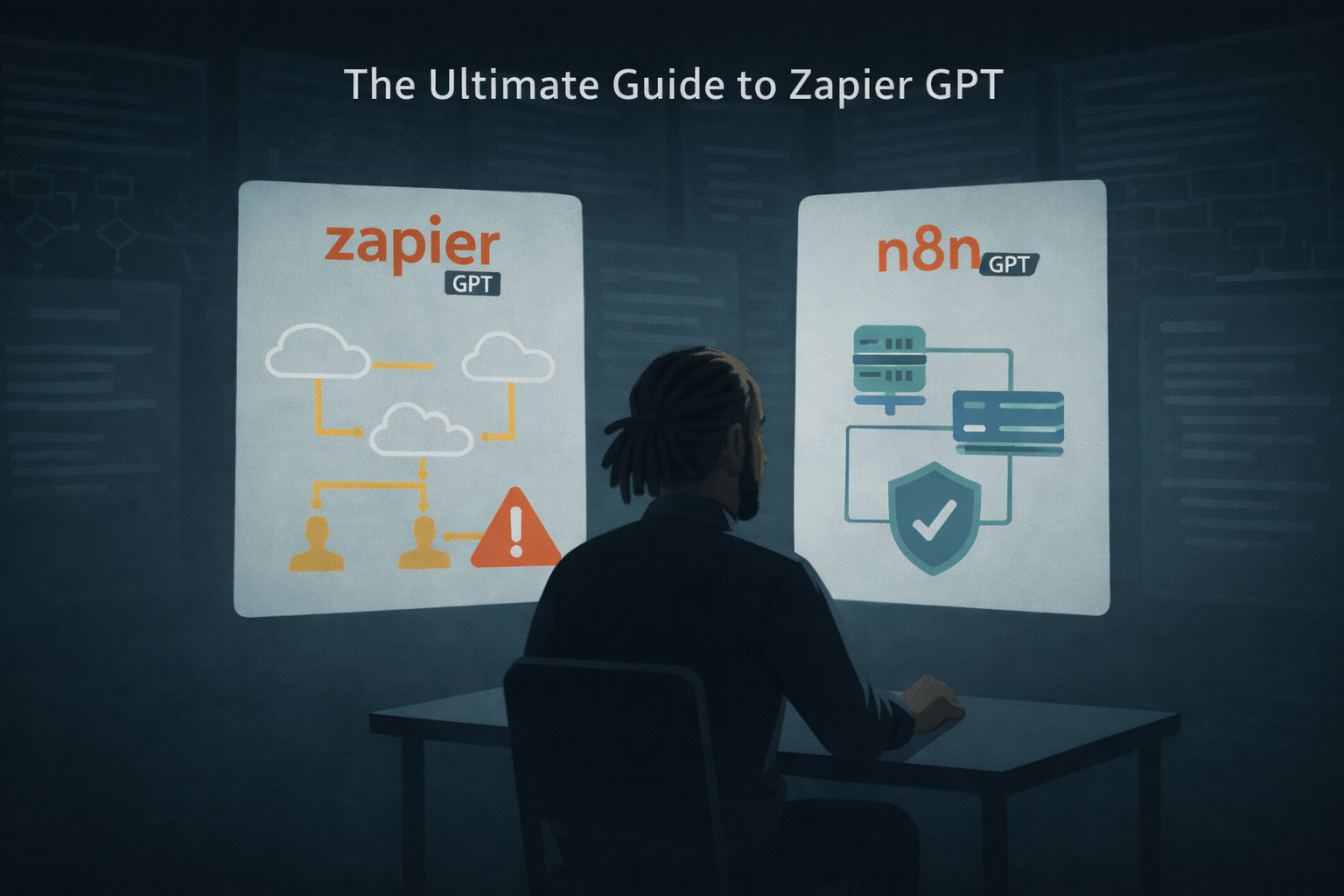
Zapier GPT vs Self-Hosted n8n
| Feature | Zapier GPT | Self-Hosted n8n (Lopez Stack) |
|---|---|---|
| Pricing | Per task (scales poorly) | Flat server cost ($5–$20/mo) |
| Data Privacy | Shared cloud | Private server |
| AI Logic | Linear | Non-linear (agents, loops) |
| Ownership | Rented | Owned |
| Compliance | Limited | GDPR-friendly |
This is the difference between:
- A demo tool
- A production system
5. Case Study: How We Built It at Lopez Productions
We recently built an AI follow-up agent for a service business.
The system:
- Ingests inbound leads
- Classifies intent with AI
- Generates tailored responses
- Logs activity to the CRM
- Triggers reminders automatically
The Cost Comparison
- Zapier GPT: ~$400/month at volume
- Self-Hosted n8n: <$10/month in infrastructure
Same outcome.
Radically different economics.
More importantly:
- No third-party data exposure
- No task throttling
- No surprise bills
That's what production-grade automation looks like.
6. Final Verdict: Prototype vs Production
Let's be clear:
- Zapier GPT is great for experimenting
- n8n is what you use when it actually matters
If you're building:
- Client-facing systems
- Revenue-critical workflows
- AI agents that scale
Then renting automation is a losing strategy.
Ready to Own Your Automation?
At Lopez Productions, we help businesses:
- Migrate from Zapier to self-hosted n8n
- Design secure AI agent architectures
- Reduce automation costs by 10–50x
- Regain control over their data
👉 Start with a Secure Automation Audit
We'll review your current workflows and show you exactly what should be self-hosted — and why.
Related Playbook Articles
Explore more automation and AI workflow guides: